Osaka
Memoirs of a GeishaOsaka is the industrial center around which Iwamura Electric’s history and much of its wartime and postwar struggle turn. The city is where the Chairman founded the company, where Nobu joined him and helped secure its survival, and where bombing later destroyed half its factories. In Sayuri’s account, Osaka is not merely a business address: its rise and ruin bind together invention, partnership, wartime loss, and the uncertain work of rebuilding.
The company’s beginnings
At seventeen, the future Chairman went to work for a small electric company in Osaka, supervising crews that installed wiring for factory machinery. As demand grew for electric lighting in homes and offices, he designed a fixture that would let two bulbs operate in a socket made for one. When his employer declined to manufacture it, he left the company in 1912, at twenty-two and shortly after marrying, to establish his own business in Osaka. The account presents the city as the setting for both his practical training and the decision to turn an unaccepted invention into the foundation of an independent company.
The new Iwamura Electric struggled at first, but in 1914 it won the wiring contract for a new building on an Osaka military base. Nobu, then still serving in the military and having difficulty finding other work because of his war wounds, was assigned to oversee the company’s work. He and the Chairman became friends; when the Chairman offered him a job the following year, Nobu accepted. Their partnership began through a concrete project in Osaka, before it became the celebrated collaboration on which the company’s reputation rested.
A city tied to the company’s identity
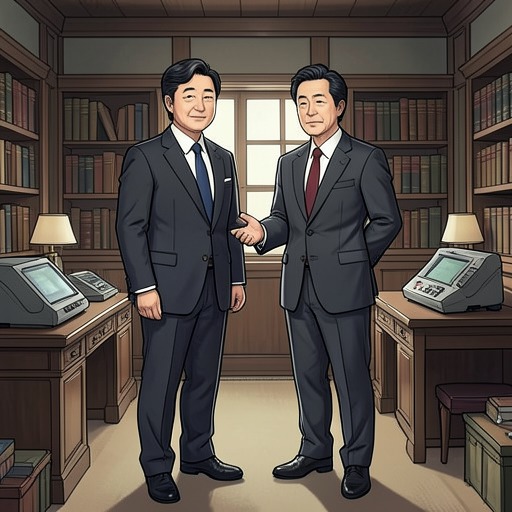
Iwamura Electric was based in Osaka and competed with Osaka Electric, its larger rival in western Japan. Although the rival was bigger, the articles Sayuri later found described Iwamura Electric as more innovative and better regarded. The Chairman led the company’s growth and direction, while Nobu managed it. Their complementary roles made the firm’s story inseparable from their partnership: the Chairman’s inventive ambition needed Nobu’s management, and the Chairman publicly credited Nobu with helping the company survive crises. Nobu had brought in investors and saved it from ruin in the early 1920s.
The company’s first product, a ceramic socket that allowed two bulbs in a single-bulb fitting, became a visual emblem of that history. In a frequently reproduced photograph, the Chairman holds the fixture while Nobu stands beside him in a formal, attentive pose. The object represents more than the Chairman’s ingenuity: it marks the enterprise’s beginning, while the partnership pictured around it suggests how the company’s identity depended on both men’s different contributions.
Wartime destruction and its human reach
During the war, the Chairman resisted government demands that the company cooperate. By the time he agreed, the war was nearly over, and, as Nobu explained to Sayuri, nothing Iwamura Electric made for the government was taken into battle. That refusal did not protect the company from postwar scrutiny. The Americans classified Iwamura Electric as a zaibatsu, and Nobu feared it could be seized, with its assets sold to pay reparations. The company faced a decision about its future even before the physical scale of the damage could be put aside.
The bombing made that danger tangible. Two of Iwamura Electric’s four factories were destroyed. Nobu sent Sayuri a fist-sized piece of concrete, wrapped in paper, string, and newspaper, explaining that it was rubble from the Osaka factory. He connected the fragment to the fan she had given him: if her gift represented a piece of herself, he said, the concrete was a piece of himself too, and he wanted her to help turn it into a lovely jewel. The exchange makes a ruined industrial remnant carry the weight of the company’s uncertain survival and the personal bond between its people.
Osaka’s destruction also appears through the uneven fates of those who lived or worked there. During raids on the city, Sayuri and the Arashino family, sheltering in Kyoto, watched fires redden the moon and saw ash carried as far as their home, fifty kilometers away. Sayuri worried about the Chairman and Nobu, who had homes in Osaka as well as Kyoto and whose company was based in the city. At the same time, the story resists any simple equation between prosperity and safety: geisha Raiha and the sumo wrestler Miyagiyama were killed in the Tokyo firebombing, while Pumpkin survived repeated bombing near the Osaka lens factory where she worked. These scattered outcomes frame wartime survival as unpredictable, even for people whose circumstances once seemed secure.
Postwar routes through the city
After the war, Osaka remained a practical point of connection between Sayuri’s world and the company’s efforts to recover. When Sayuri, Mameha, Pumpkin, and an older geisha named Shizue traveled there by train, their small bus from Osaka Station took them to the airport. The trip’s purpose was linked to an opportunity arranged by Iwamura Electric: they were to fly to Amami on return journeys that would otherwise have been empty, after carrying American officers from Okinawa to Osaka. The episode places Osaka on a postwar transport route shaped by the company’s business connections and by the use of available aircraft.
That journey’s business setting is also visible before the flight: the Chairman, Nobu, and the Minister were already aboard, talking with a regional director of Mitsubishi Bank and the director’s son. Meanwhile, the memory of the bombed factories persisted in Nobu’s concrete fragment and in his warning that the whole company might not survive the next few years. Osaka therefore holds two stages of the same history at once: the city where a small firm began with an electrical invention, and the place from which its damaged postwar future had to be negotiated.
Narrative significance
Osaka gives Iwamura Electric’s success and crisis a specific geography. The company’s origin is grounded in factory work, a military-base contract, and a new two-bulb socket; its postwar vulnerability is grounded in two destroyed factories and a fragment of their concrete. Between those points, the city also marks the partnership of the Chairman and Nobu, whose work sustained the enterprise through earlier crises and whose shared exposure to wartime destruction gives the company’s fate a personal dimension.
The novel’s return to Osaka is thus both material and relational. It is a place of industry and commercial rivalry, but also a source of rubble that can be carried elsewhere and offered as a piece of oneself. That movement from working factory to broken fragment, from city-based enterprise to uncertain rebuilding, makes Osaka a lasting measure of how public history enters private lives.